
Why Is a Squash Scoreboard Important?
By the Multi Score Screen team9 min read
Main guide: Squash scoreboard guide
In this guide
Why Is a Squash Scoreboard Important?
Squash is one of the fastest and most physically demanding racket sports in the world. Rallies can last for dozens of shots, the ball moves at high speed inside an enclosed glass-back court, and momentum can shift within seconds. Keeping track of the score in the middle of that intensity is not always straightforward.
Unlike sports played on an open court, squash is contested inside a four-walled box. Players are focused on the T, retrieving drops and boasts, and reacting to a ball that can be difficult to follow even for experienced spectators.
This is where a squash scoreboard becomes an important part of the modern squash court experience.
A digital squash score screen makes live match information visible, easy to understand and accessible to everyone on and around the court.
What Is a Squash Scoreboard?
A squash scoreboard is a system used to display the current score of a squash match.
Traditional squash courts often rely on a small manual flip-scoreboard mounted on the wall, or on players and referees calling the score out loud between rallies.
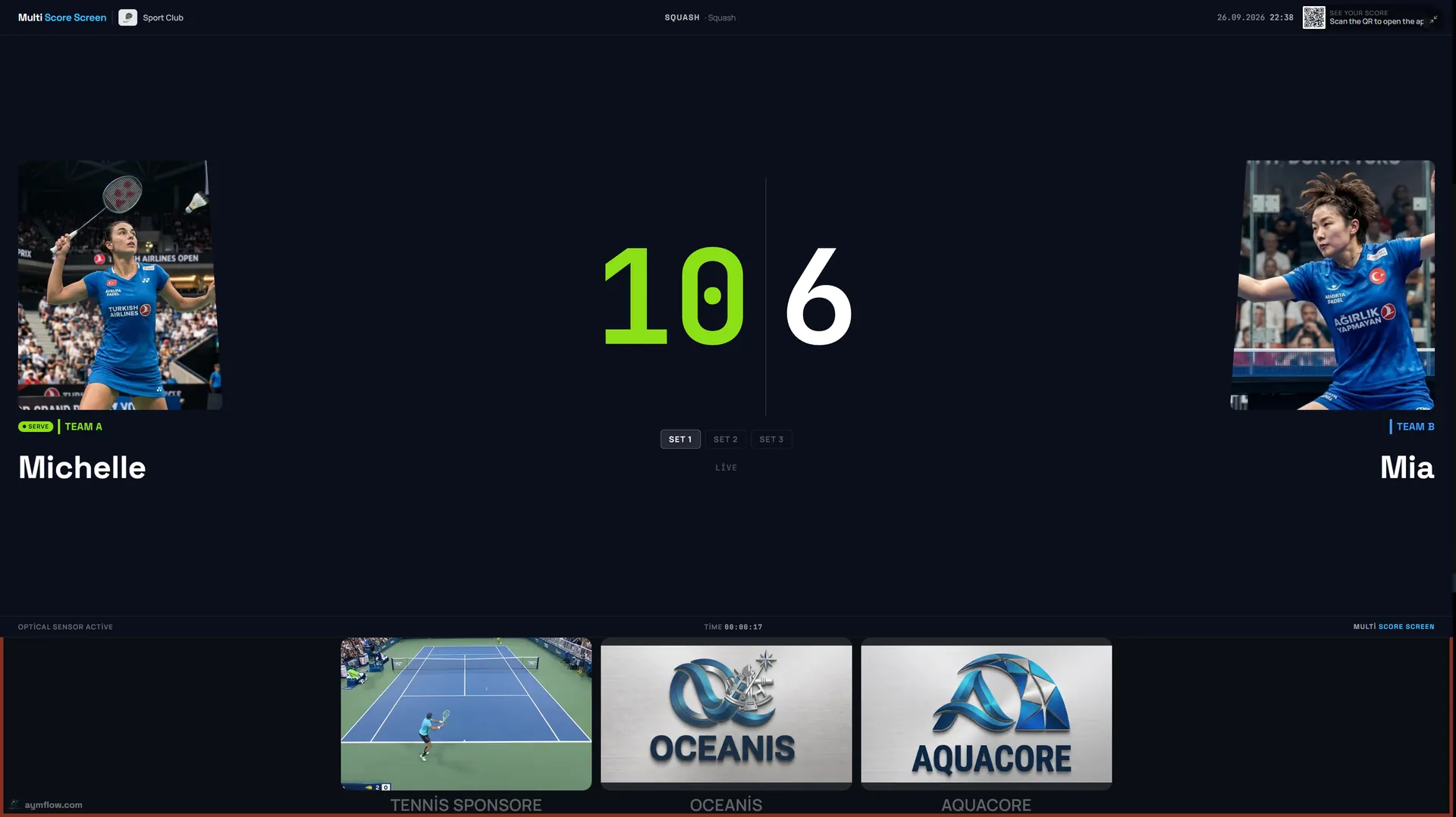
A digital squash score screen takes this further by displaying live match information on a screen inside or around the court. Depending on the system, the screen can show:
- Player names
- Current game score
- Games won by each player
- Match status
- Serving side
- Tournament or club branding A modern scoring platform such as Multi Score Screen is designed to turn an existing court TV into a live scoreboard, supporting squash alongside tennis, padel, badminton, table tennis, volleyball, pickleball and padbol.
Why Is Squash Scoring Difficult to Follow?
Modern squash uses Point-A-Rally Scoring, usually written as PARS. Under PARS, a point is scored on every rally regardless of who served, and games are normally played to 11 points. If the score reaches 10-10, a player must win by two clear points, so a close game can continue well past 11.
A match is typically the best of five games, which means the scoreline a spectator needs to track includes the current point score, the games won by each player, and how close the match is to finishing.
Because rallies happen quickly and players rarely pause between points, it is easy for a score to be missed entirely, especially by someone watching from outside the glass back wall or arriving partway through a match.
This layered structure is exactly why a clear digital squash scoreboard can make such a difference.
1. A Squash Scoreboard Makes the Match Easier to Follow
During a competitive squash match, players are focused on court position, shot selection and physical recovery between rallies.
Remembering the exact score should not have to compete with that concentration.
A visible squash score board gives players and referees an immediate reference point, instead of pausing play to confirm the count out loud.
This becomes especially useful during long games, tie-break situations at 10-10, and back-to-back matches on a busy club night.
2. It Reduces Score Confusion
Squash scoring can lead to disagreement, particularly in recreational and club-level matches without an official marker.
After a fast exchange of rallies, a player may remember the score differently from their opponent.
A shared digital scoreboard provides one visible source of information that can be seen by:
- Both players
- The marker or referee
- Coaches
- Spectators
- Club staff This can reduce disputes and help the match continue without unnecessary interruptions.
3. It Improves the Player Experience
A modern squash club is about more than four walls and a ball.
Players increasingly expect professional facilities, easy court booking and technology that matches the standard they see on the PSA tour.
A digital squash scoreboard is a relatively simple addition that can make a club court feel significantly more professional, while players stay focused on the rally instead of the running total.
4. It Makes Squash Matches More Professional
Professional squash has increasingly moved toward glass-back and glass-sided showcourts with clear, digital scoring for exactly this reason: players, referees and spectators all need to know the state of the match at a glance.
The same principle applies to local clubs and leisure centres.
A digital squash score screen can display player names, current score and games won in a clean, consistent interface for:
- Club leagues
- Ladders and box leagues
- Junior squash coaching
- Local tournaments
- Social matches
5. A Digital Squash Scoreboard Improves the Spectator Experience
Watching squash from outside a glass-back court already asks a lot of a spectator's attention. Adding the challenge of tracking an unclear or missing score makes it harder to enjoy the match.
A spectator arriving mid-match may want to know immediately: who is winning, what the current point score is, and how many games each player has won.
A visible squash scoreboard answers these questions instantly, which matters most during club open days, junior tournaments and any event where several courts are being watched at once.
6. It Makes Squash Tournaments Easier to Follow
Tournament environments create a much greater need for clear scoring, since several courts may be in use at the same time with matches at different stages.
A consistent digital scoring system across every court makes an event easier to understand for players, officials and spectators moving between courts, instead of relying on scoreboards that look different court to court, or none at all.
7. It Can Turn an Existing Court TV Into a Scoreboard
One of the major advantages of a software-based squash scoring system is that a club does not need to purchase dedicated scoreboard hardware.
If a court already has a compatible screen, whether mounted beside the court or above the entrance, software can turn that display into a live scoreboard.
Multi Score Screen is built around this concept, using an existing screen rather than installing proprietary equipment.
8. One Platform Can Support Multiple Sports
Many squash clubs also run padel, badminton, table tennis or tennis facilities. Installing a separate scoring solution for every sport creates unnecessary complexity and cost.
Multi Score Screen is designed to support eight sports through one platform: tennis, padel, badminton, squash, table tennis, volleyball, pickleball and padbol, so a facility can use the same scoring platform while applying the correct format for each sport it offers.
9. Live Squash Scoring Can Extend Beyond the Court
A modern squash live score system does not have to be limited to the screen beside the court.
A QR code can give spectators, friends, family members or tournament organisers a live link to the match from a mobile device, so anyone who cannot watch through the glass back wall can still follow along in real time.
10. It Can Support Squash Club Branding
A squash court screen does not have to be used for scoring alone.
Between matches, the same display can carry club announcements, ladder results, tournament draws, sponsor messages or event promotions, turning an ordinary courtside screen into a communication channel with both a sporting and commercial purpose.
11. It Is Useful for Multi-Court Squash Facilities
Managing a single squash court is straightforward. Managing six, eight or twelve courts at once, as many leisure centres and squash clubs do, is a different challenge.
A multi-court facility needs scoring that is easy to use, consistent from court to court, and centrally manageable, so staff are not treating every court as a separate system.
Squash Scoreboard vs. Traditional Scoreboard
| Traditional Scoreboard | Digital Squash Scoreboard |
|---|---|
| Manual flip score or called-out count | Digital score input from a phone |
| Limited information | Live match information |
| Usually dedicated to one sport | Can support multiple sports |
| Separate hardware | Can use an existing TV |
| Limited branding | Digital branding opportunities |
| Local viewing only | Potential remote viewing via QR code |
| More difficult to scale | Designed for multi-court facilities |
For a friendly knock-up, a traditional scoreboard, or none at all, may be perfectly adequate. For clubs, academies and tournament venues, digital scoring provides a far more complete solution.
What Should You Look For in a Squash Scoreboard?
Clear score display
Players and spectators should be able to read the score easily, even through a glass-back wall.
Fast score updates
The display should update immediately after each rally, since squash points come quickly.
Simple score input
A marker, referee or player should be able to update the score without a complicated procedure.
Support for PARS scoring
The system should understand games to 11, win-by-two rules and best-of-five match formats.
Existing screen compatibility
Using a TV a court already owns reduces the need for additional hardware.
Multi-sport capability
For clubs that also run padel, badminton or table tennis, one platform covering every sport is far more practical.
Multi-court management
Larger clubs should be able to manage every court from a single dashboard.
Remote score access
QR-based access lets a match be followed away from the court itself.
How Multi Score Screen Fits Into Modern Squash Facilities
The idea behind Multi Score Screen is simple: the TV already installed at a squash club can become far more useful than it currently is.
Instead of sitting unused between bookings, it can become a live squash scoreboard the moment a match begins. A marker, player or member of staff updates the score from a phone, and the result appears instantly on the court display.
The same platform then supports every other sport the facility offers, without needing a separate scoring system for each one. You can learn more about how Multi Score Screen works across all eight supported sports on the What Is Multi Score Screen page.
The Future of Squash Court Technology
Squash facilities are becoming increasingly connected, from online court booking to digital memberships and live streaming of showcourt matches.
A digital squash scoreboard is one of the simplest ways to bring this technology directly onto an everyday club court, connecting the physical match with a digital information system that is visible to everyone around it.
The goal is not to change how squash is played, but to make the score easier to see, easier to trust, and easier to follow, whether you are on court, courtside, or watching remotely.
Conclusion
A squash scoreboard may seem like a small piece of equipment, but it plays a meaningful role in the modern squash court experience. PARS scoring, fast rallies and an enclosed playing area all make a clearly visible score more valuable, not less.
For squash clubs, academies and multi-court facilities, a digital squash scoreboard can also create a more professional environment and open up opportunities for live scoring, remote viewing and digital branding.
With a platform such as Multi Score Screen, an existing court TV can become a live squash scoreboard, while the same platform supports tennis, padel, badminton, table tennis, volleyball, pickleball and padbol on other courts.
If you are looking to add live scoring to your squash courts, contact Multi Score Screen to discuss your facility and scoring requirements.
Explore the Multi Score Screen digital scoreboard for padel, tennis, pickleball and 5 more sports →