Squash Tournament Scoreboard: Running Every Court on Event Day
By the Multi Score Screen team7 min read
Main guide: Squash scoreboard guide
In this guide
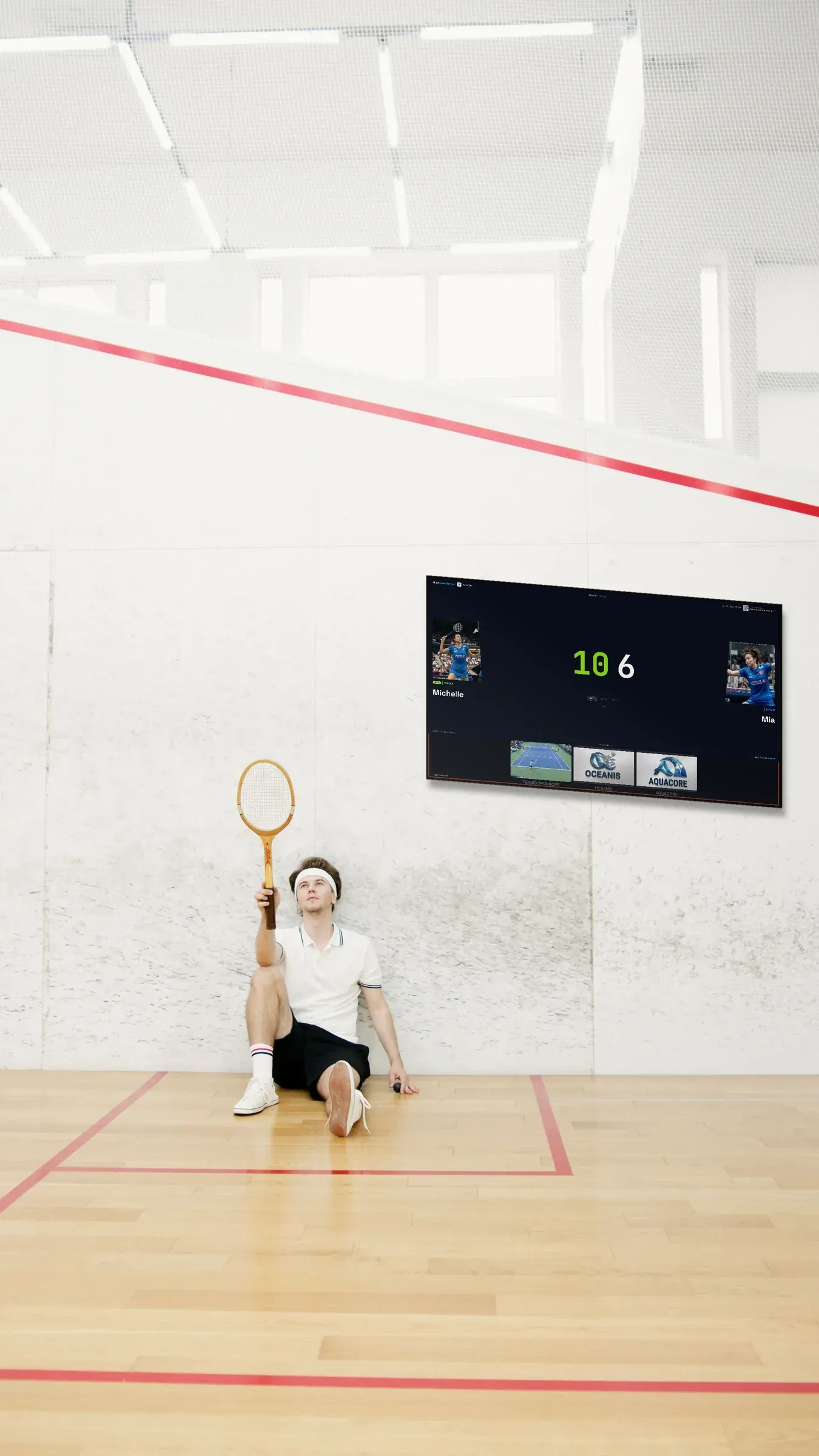
A squash tournament scoreboard shows the live score of every match on the TV outside its court and lets the desk run the whole draw from one dashboard. Squash events have a particular problem: the action happens inside closed boxes. Spectators crowd the gallery or peer through the glass back wall, players waiting for their match cannot see in, and the desk at the end of the corridor has no idea which match is at 2-0 and which has just gone to a fifth game. When each court shows its score outside, the whole event becomes visible. Multi Score Screen turns the TVs a club already has into squash scoreboards.
Why squash events are hard to follow
A squash club on tournament day is a row of closed courts along a corridor. Each match is visible only to the people standing at its back wall or in its gallery. The desk depends on players reporting results, and on markers' score sheets that have to be collected after every match. Players warming up do not know whether their court will be free in five minutes or forty, because a squash match can end 3-0 in twenty minutes or run to five long games.
PAR scoring makes the score move fast. Every rally counts, so a game can swing from 4-8 to 10-8 in a couple of minutes. Without a screen, nobody outside the court can tell.
What the scoreboard shows on each court
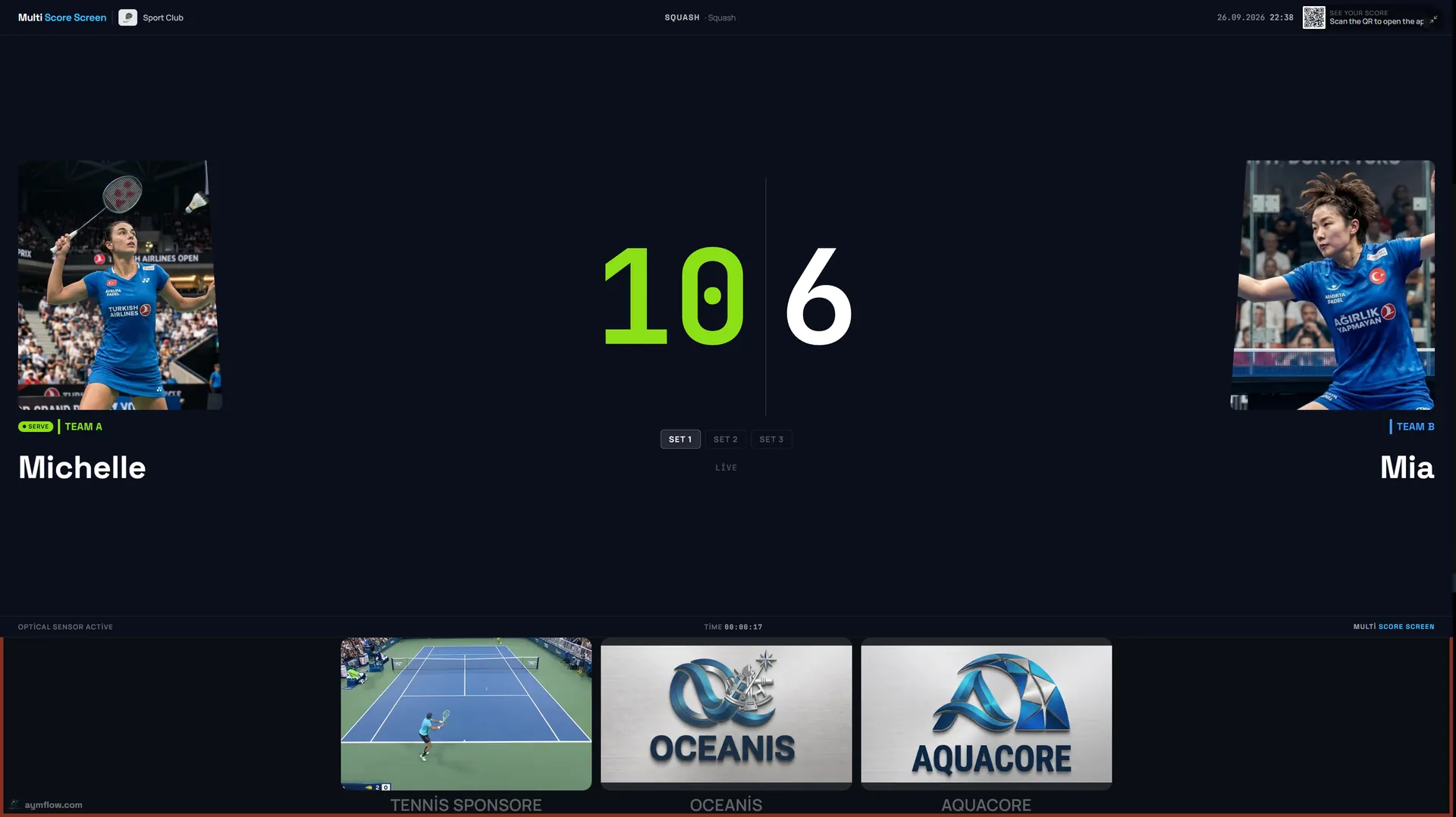
Each TV shows the players' names and photos, the rally score, the game number, games won and a serve indicator. The scoring engine knows the PAR-11 rule: a game is won at 11, and from 10-10 a player needs a two-point lead, so 12-10 or 13-11. The marker records who wins each rally; lets are replayed and simply not tapped.
Choosing the event format
| Format | Typical use | What to plan |
|---|---|---|
| Box leagues | Club ladders and monthly boxes | Many short fixtures; one court per box |
| Knockout | Club championships, closed events | Uneven finish times |
| Groups then knockout | Junior events, opens with guaranteed matches | A clear break between stages |
| Team fixtures | Inter-club leagues | Order of play across courts |
Most squash matches are best of five games. Some junior or social events play best of three. If your event uses a shorter format, check it with us when you request a demo so you see it on screen before the day.
Setting up the courts
- Number the courts on the dashboard exactly as the doors are numbered.
- Set each event court to tournament mode with squash as the sport.
- Create the draw, enter the names and assign the first round to courts.
- Open the scoreboard on every TV and check that each shows its own QR code and PIN.
- Play a test rally on every court and take one to 10-10 to check the two-point rule.
From then on, the Court Status Board shows which courts are empty, in use or reserved, and the desk works from it for the rest of the day.
Markers, referees and self-scoring
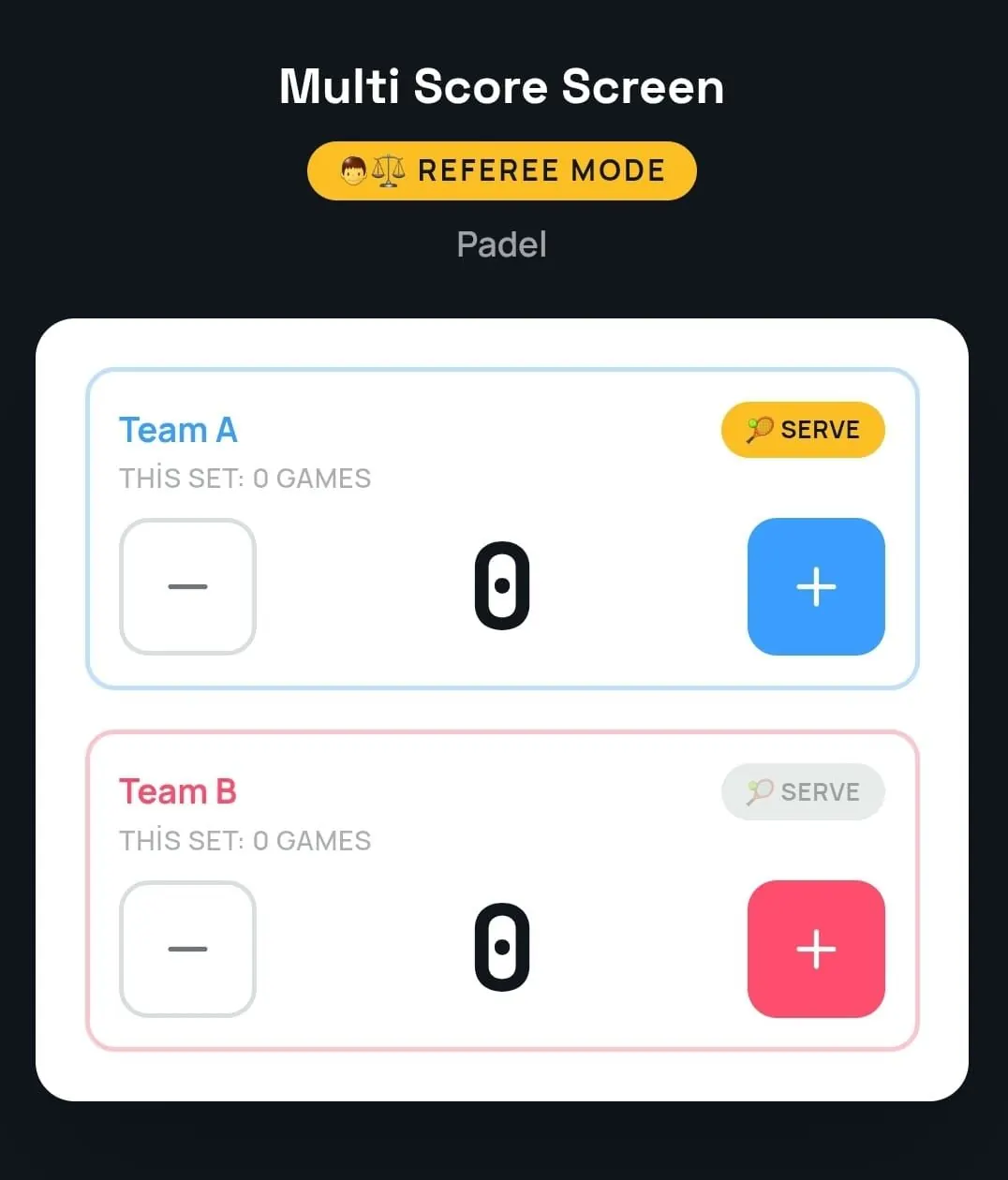
Squash has a long tradition of a marker calling the score and a referee ruling on lets and strokes. In referee mode, the marker gets a phone console with plus and minus buttons for each player and the serve indicator, and the TV follows the official score. The referee's decisions stay with the referee; the marker simply records the outcome. At club events without officials, the loser of the previous match often marks, or one player taps between rallies. Mistakes are fixed with point or game undo. The phone side is explained in the squash scoreboard app guide.
Calling matches from live scores
The desk's question is always which court will be free next. With every score visible, the answer is clear: a match at 2-0 and 9-3 is almost over; one at 2-2 and 6-6 in the fifth is not. Call the next match to the court that is about to finish so the players can warm up outside it.
Squash has natural breaks that help: the short interval between games is the right moment to tell the next players to get ready.
Spectators and players in the corridor
Each TV shows a QR code that opens that match live in any mobile browser, with no app to install. Parents at a junior event follow their child's court from the café, and players can check whether their court is about to free up without crowding the gallery. When the match ends, the winner screen shows the game scores before the court resets. Player names and photos used for a match are temporary and are removed when it ends.
Sponsors on event day
Tournament days fill the club, and every court screen keeps a sponsor strip under the score. Between matches, while the court is empty, full-screen images or videos can run. How to sell that space is covered in squash scoreboard sponsorship.
Preparing markers
Brief your markers the evening before. Let each one score a few rallies in referee mode: plus and minus, how the serve indicator follows, and how undo works. Then take a court to 10-10 together and watch the game continue. Ten minutes of practice saves arguments in the final.
A junior open, step by step
A club with four courts runs a junior open for 48 players. In the morning, groups of four play on each court, with the players off court marking. The desk watches the Court Status Board and calls each group's next match as soon as a court frees up. In the afternoon, the finals move to the glass-back show court, with the Gold theme and an experienced marker in referee mode. Where to put the screen for each court is covered in squash court scoreboard.
After the event
When the last final is over, switch the courts back to rental mode so normal bookings run the next day. Statistics show reservations and occupancy by sport and can be exported as CSV, useful for the report to the committee. Ask the markers what worked and note it for next year.
Choosing a plan for an event club
Each court needs a licence on the TV it already has. A single show court fits Starter, $44/month for one court and one sport. Up to five courts fit Pro, $134/month, which also unlocks all eight sports. Up to ten courts fit Elite, $224/month, with white-label branding. A permanent installation can also be bought on Unlimited: $1,299 per court once, with no term limit and optical sensors included. Compare on the pricing page.
Frequently asked questions
Can we run a squash tournament across all courts from one dashboard?
Yes. Tournament mode handles boxes or knockout draws across several courts, and the Court Status Board shows which courts are free.
Does the scoreboard handle 10-10 in PAR-11?
Yes. From 10-10 a player needs a two-point lead to win the game, and the scoreboard applies that automatically.
Can markers score from a phone?
Yes. Referee mode gives plus and minus buttons for each player and the serve indicator, and the TV shows the official score.
Can we play best of three at a junior event?
Check shorter formats, such as best of three, with us before the event so you see them on screen.
How do parents follow a match from outside the court?
They scan the QR code on the TV and follow the live score in their phone's browser.
Planning your next squash event? Request a demo and we will set up a test draw on your court TVs.
Explore the Multi Score Screen digital scoreboard for padel, tennis, pickleball and 5 more sports →