Digital vs Manual Pickleball Scoreboard: Flip Scorers or a Court TV?
By the Multi Score Screen team6 min read
Main guide: Pickleball scoreboard guide
In this guide
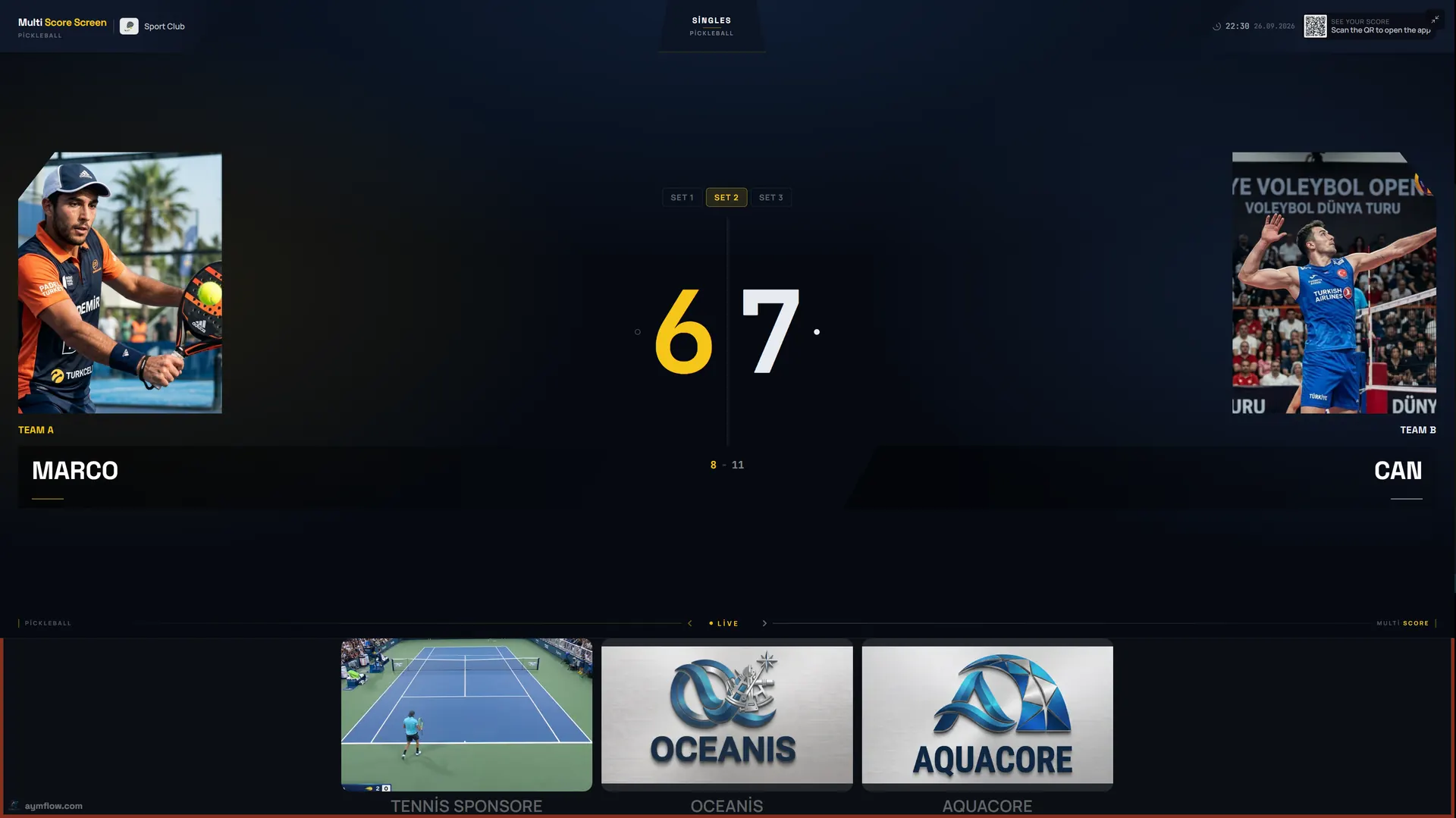
A digital pickleball scoreboard keeps the score, the serving side and the server number on a court TV that is updated from a phone. A manual one is usually a flip scorer clipped to the net or fence, turned by hand after each point, or simply the three-number call spoken before every serve. Manual scorers are cheap and handy. Their weakness is the part of pickleball that causes most arguments: whether the last rally was a point or a side-out, and whether the server is one or two.
How pickleball is scored manually
- Flip or dial scorers clipped to the net post or fence, with two numbers and sometimes a server marker.
- Wrist or paddle counters worn by a player.
- Calling the score. The server calls three numbers before every serve, as the rules require, and everyone checks it in their head.
Calling the score is part of the game and should stay that way. The problem is what happens when the call and the flip scorer disagree.
Where manual scoring breaks down in pickleball
- Side-outs. In side-out scoring, a rally won by the receiving side does not change the score. Players who are used to rally scoring in other sports turn the scorer anyway.
- Server one or two. In doubles each side has two servers. After a long dink rally, "were you first or second server?" is the most common question in the game.
- Turning the card. Flip scorers are updated by whoever remembers. Halfway through a game they are often wrong.
- Busy banks of courts. A small clip-on scorer is hard to read from the far baseline and invisible from the next court or the waiting area.
- No record. When an event needs results, someone has to write them down and walk them to the desk.
Side by side
| Manual (flip scorer, counter, memory) | Digital pickleball scoreboard on the court TV | |
|---|---|---|
| Side-out vs point | Depends on the players | Applied automatically in side-out scoring |
| Server number | Rarely shown | Always shown with the serving side |
| Three-number call | Spoken from memory | Readable from the screen |
| Rally scoring | Manual | Supported as a format |
| Readable from the far baseline | Sometimes | Yes, large figures |
| Followed off court | No | Live link via QR in any mobile browser |
| Corrections | Turn back and argue | Point and game undo |
| Open play turnover | Reset by hand | QR code and PIN refresh after every game |
| Sponsors | Banner on the fence | Strip under the score; full-screen ads while the court is empty |
| Events | Paper sheets | Round robin or knockout across courts from one dashboard |
| Power and network | None | TV with internet and a streaming app or HDMI |
What the digital option needs
- A screen for each court, clearly named and visible from the court entrance. See outdoor pickleball court scoreboard.
- Internet at each screen; banks of outdoor courts often need one outdoor access point, explained in the pickleball scoreboard Wi-Fi guide.
- A phone for the scorer. Players scan the QR code on the TV and enter the PIN; there is nothing to download.
When manual is still fine
- Drilling and warm-up games where nobody keeps score.
- A regular foursome that calls the score carefully and never argues.
- Temporary courts with no power, such as a pop-up event on a car park.
Many clubs keep flip scorers on spare courts and put screens where the games matter most: league courts, event courts and the busiest open-play courts.
What changes for beginners
Pickleball attracts many newcomers, and side-out scoring is the hardest thing for them to learn. On a court with a digital scoreboard, beginners see the score behave correctly: the number does not move when the receiving side wins, and the server number changes. Coaches running beginner clinics often find that the screen teaches the scoring faster than any explanation.
A two-week trial
Put a digital scoreboard on your busiest open-play court for two weeks and keep flip scorers on the others. Then ask: were there fewer "what's the score?" stoppages? Did groups rotate faster? Which court did players queue for? If it does not convince you, the flip scorers are still there.
Before you switch
- Which courts host leagues, events or the busiest open play?
- Can each of those courts have its own screen, facing the right way?
- Can each screen reach the internet where it will hang?
- Who will score: players, coaches or referees?
- Do you want sponsors on the screens from the start?
- Which plan fits your number of courts and sports?
Multi Score Screen is licensed per court. Starter is $44/month for one court and one sport, Pro is $134/month for up to five courts and all eight sports, Elite is $224/month for up to ten courts with white-label branding, and Unlimited is $1,299 per court one-time with no term limit. See the pricing page and the pickleball scoreboard buying guide.
Frequently asked questions
Is a digital pickleball scoreboard worth it for open play?
Usually, on the busiest courts. It removes most scoring stoppages and the QR code lets each new group start its own game without staff.
Do flip scorers show the server number?
Some have a marker, but it has to be moved by hand and is often forgotten.
Does the digital scoreboard handle side-out scoring?
Yes. You tap who won each rally and it decides whether that is a point or a change of server.
Do we need dedicated scoreboard hardware?
No. It runs on a TV or display the court already has and is controlled from a phone.
Can we keep flip scorers as a backup?
Yes. Many clubs keep them on courts without screens.
Want to compare on your own court? Request a demo and we will show a live pickleball game on your TV.
Explore the Multi Score Screen digital scoreboard for padel, tennis, pickleball and 5 more sports →