Digital vs Manual Padel Scoreboard: Flip Cards, Counters or a Court TV
By the Multi Score Screen team6 min read
Main guide: Padel scoreboard guide
In this guide
A digital padel scoreboard shows the live score of a match on a screen that updates from a phone; a manual one relies on players moving numbers by hand, or simply remembering. Both can work on a quiet social court. The difference shows up in the moments padel is known for: a long game that swings back to deuce, a golden point that decides a set, a tiebreak with a change of ends every six points, and a crowd at the glass that wants to know what just happened.
The manual options on padel courts
Padel clubs that do not run screens usually rely on one of these:
- Flip or slide counters on the fence or the glass door. Players turn cards or slide markers for games and sets after each game.
- Wrist or pocket counters. A small device that one player carries and updates.
- Calling the score aloud. The server announces the score before each point, and everyone keeps it in their head.
All three are familiar and cost little. They also share the same weakness: the scoreboard is only as good as the last person who remembered to update it.
Where manual scoring breaks down in padel
Padel puts more pressure on the score than most club sports:
- Long deuce games. With advantage scoring, a game can go back to 40-40 several times. Nobody flips cards for points, so the game score lives in memory.
- Golden point. At 40-40 the next point decides the game, and the receiving pair chooses the side. If one pair thinks it is 40-30, the argument starts before the point is played.
- Tiebreaks and match tiebreaks. Points are counted 1, 2, 3, ends change every six points and the serve passes in pairs. A flip counter does not help with any of that.
- Doubles. Four players means four memories, and they do not always agree.
- Reading distance. A small counter on the door is hard to read from the far baseline 20 metres away, and invisible from the café.
Side by side
| Manual (flip cards, counters, memory) | Digital padel scoreboard on the court TV | |
|---|---|---|
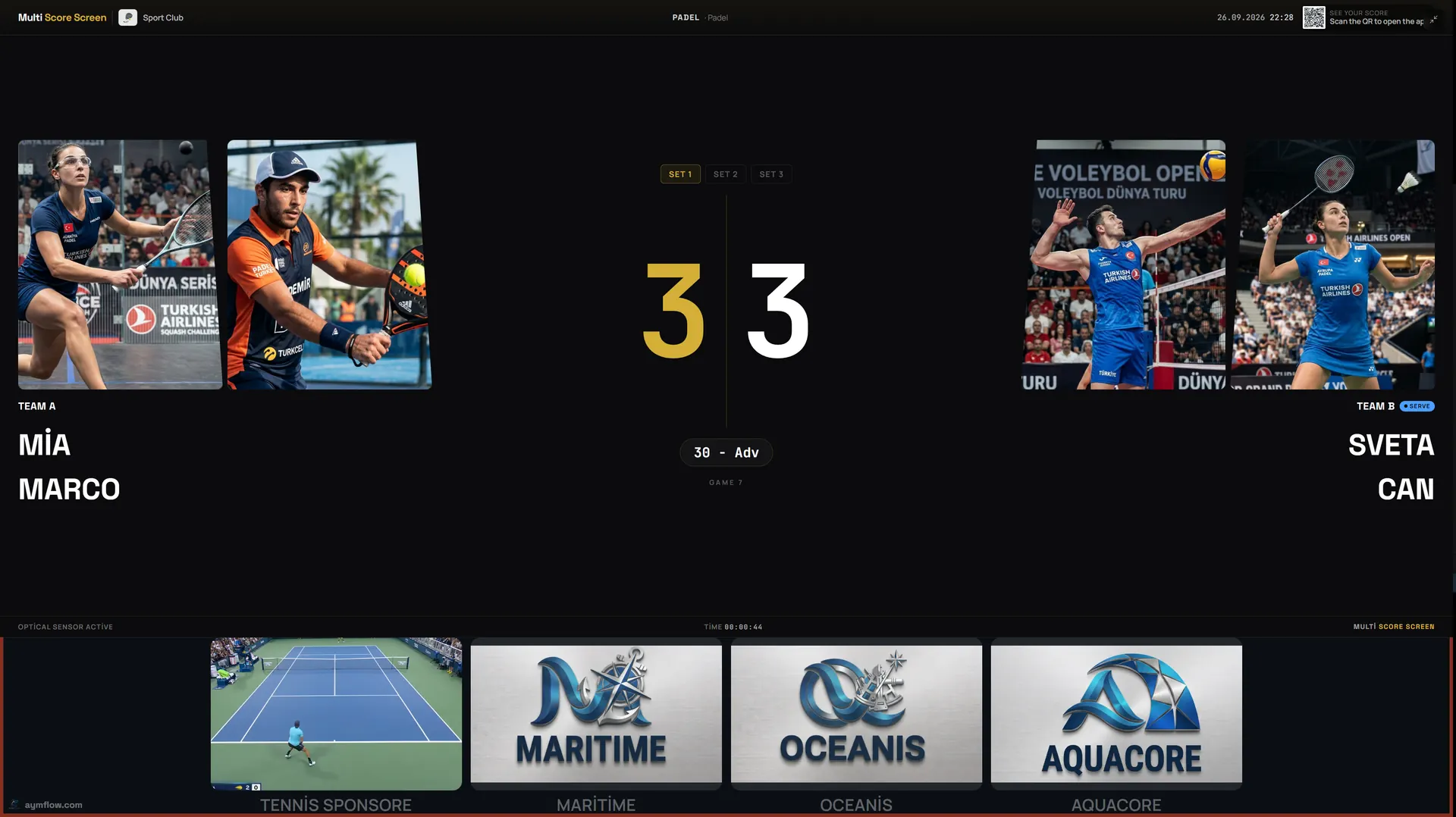
| Game score (15, 30, 40, deuce) | Usually in players' heads | On screen, large, after every point |
| Golden point or advantage | Players must agree beforehand | Set for the match; the screen follows it |
| Tiebreak count and serve | Easy to lose track | Counted on screen with a serve indicator |
| Readable from the far baseline | Rarely | Yes, with large game-score numerals |
| Spectators off court | No | Live score by QR code in any mobile browser |
| Corrections | Argue and flip back | Point and game undo |
| Sponsors | A banner on the fence | Strip beneath the score and full-screen slots between matches |
| Tournaments | Paper sheets and runners | Brackets across courts in one dashboard |
| Power and network | None needed | TV with internet and a streaming app or HDMI input |
| Effort per game | Someone flips after every game | One tap per point on a phone |
What the digital option needs
Moving from manual to digital on padel courts is mostly about the TV, not about new equipment. Multi Score Screen runs on the TV or display a court already has, controlled from a phone:
- A screen per court, mounted outside the court where everyone can read it. See the outdoor and indoor placement guide for positions and glare.
- An internet connection for each TV, by cable or Wi-Fi; our padel scoreboard Wi-Fi guide covers padel halls.
- A phone for the scorer. Players scan the QR code on the TV and enter the PIN; no app download is needed.
Most clubs have their first court live the same day they sign up.
When manual is still enough
There is no point pretending a digital scoreboard is essential everywhere. Manual scoring is often fine for:
- a single social court with regular groups who keep score by habit,
- training sessions where the score does not matter,
- temporary or pop-up courts without power or internet.
Even then, many clubs find that a screen on one showcase court changes how players see the venue, because the score, the names and the sponsors become part of the experience.
A checklist before you switch
- Which courts host leagues, tournaments or spectators? Start there.
- Is there a TV, or a place for one, outside each of those courts?
- Can each TV reach the internet at its final position?
- Who will score: players, or staff in referee mode for important matches?
- Do you want sponsors on the screens from day one?
- Which plan fits the number of courts and sports you run?
For the plan question, Multi Score Screen is licensed per court. Starter costs $44/month for one court and one sport, Pro $134/month for up to five courts and all eight sports, Elite $224/month for up to ten courts with white-label branding, and Unlimited is a one-time $1,299 per court with no term limit. Every detail is on the pricing page, and the padel scoreboard buying guide helps you compare.
Frequently asked questions
Is a digital padel scoreboard worth it for a small club?
It depends on how the courts are used. For social play, manual scoring often works. For leagues, tournaments, spectators or sponsors, a digital scoreboard on the court TV removes most score disputes and makes the court easier to follow.
Do we need to buy a dedicated electronic scoreboard?
No. Multi Score Screen runs on the TV or display a court already has, controlled from a phone.
Does a digital padel scoreboard handle golden point?
Yes. Padel matches can be scored with golden point or with advantage, and the screen follows the format set for the match.
What if players forget to tap a point?
They can add it afterwards, and point and game undo fix mistakes without restarting the match.
Can we keep a manual board as a backup?
Yes. Some clubs keep flip counters on the fence for courts without a screen or for training sessions.
Ready to compare on your own court? Request a demo and we will show a live padel match on the TV you already have.
Explore the Multi Score Screen digital scoreboard for padel, tennis, pickleball and 5 more sports →