Outdoor vs Indoor Padel Courts: Placing a Scoreboard Players Can Read
By the Multi Score Screen team7 min read
Main guide: Padel scoreboard guide
In this guide
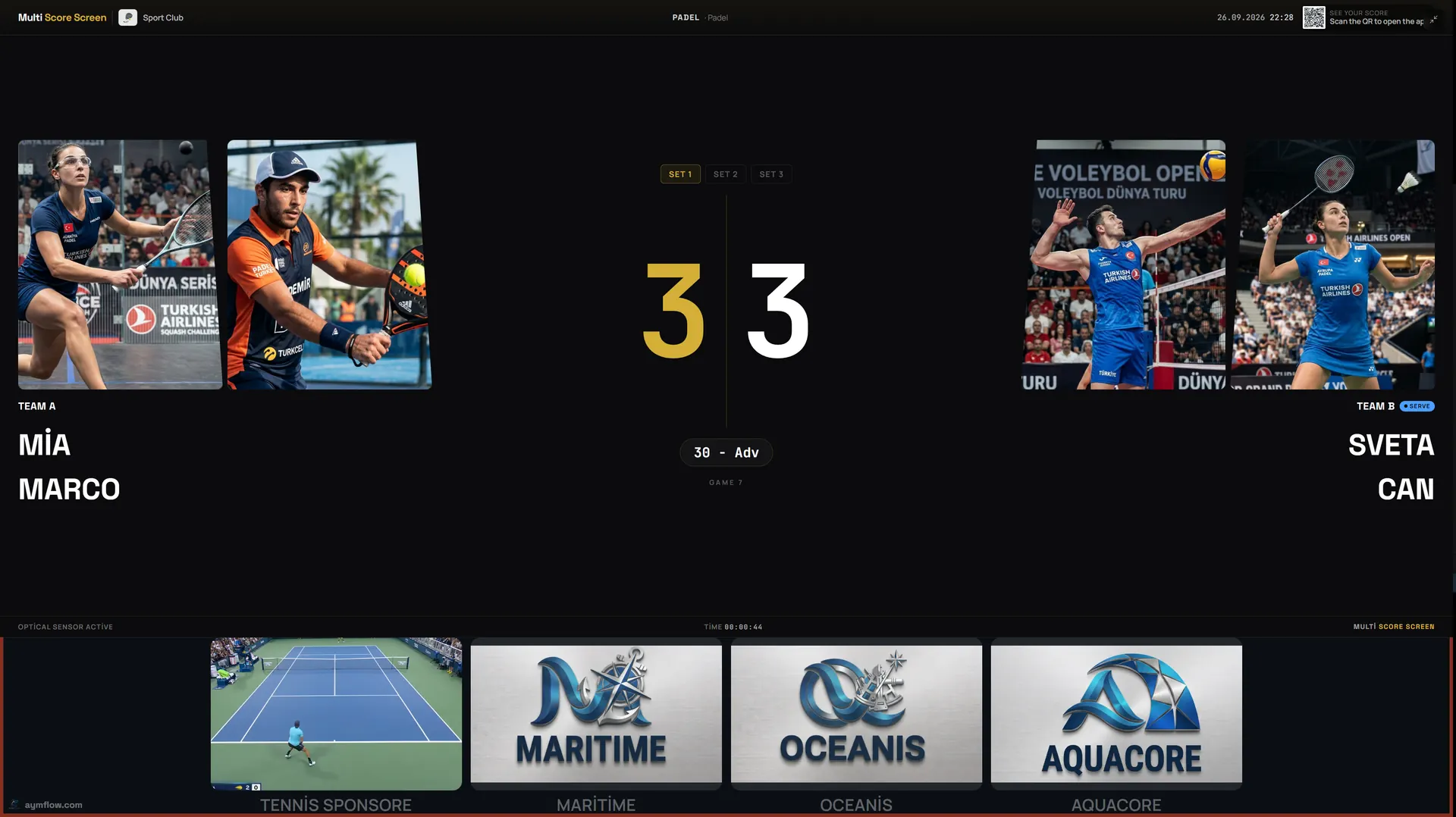
On an outdoor padel court, the scoreboard has to beat sunlight, reflections on the glass and the weather; on an indoor court, it has to beat ceiling lights, dark corners and the distance from the far baseline. In both cases the goal is the same: every player should read the score from anywhere on the 20 by 10 metre court without walking to the net. Multi Score Screen runs on the TV or display you choose for each court, so the decision is mostly about which screen goes where.
Three kinds of padel court, three different problems
| Court type | Main challenge | What helps |
|---|---|---|
| Open-air court | Direct sun, glare on glass and screen, rain, heat | Outdoor-rated or high-brightness display, shade, weather protection |
| Covered outdoor court (roof, open sides) | Bright sky behind the screen, low sun in the evening, wind-blown rain | Mount under the roof edge, angle away from the open side |
| Indoor hall | Reflections from ceiling lights, dim corners, glow lighting | Matte or anti-glare screen, lights not aimed at the TV, a high-contrast theme |
Many clubs have all three. Treat each court on its own rather than copying one mounting position everywhere.
Where the screen goes on a padel court
Padel courts are enclosed, so the TV almost always sits outside the playing area. The common positions are:
- Above or beside the back glass, facing down the length of the court. Players at both ends can see it, although the pair right under it has to look up.
- On a wall or post facing the side of the court. Good when courts stand in a row and a corridor runs alongside them, as in many indoor clubs.
- Between two courts, angled towards one of them. Avoid pointing one screen at two courts; each court needs its own score.
Whichever you choose, check three things from inside the court: can you read the game score from the far baseline, can you see it from the net, and does the glass in front of it reflect the lights or the sky?
Viewing distance and screen size
A padel court is 20 metres long, so the furthest player can be well over 20 metres from a screen mounted behind the opposite glass. Bigger numerals help, and that is why the themes keep the game score large. As a rule, test before you buy: put a TV in the planned position, open the scoreboard, and read it from the far corner. If you need to squint at 30-40, go bigger or move the screen.
Players also look at the score through the side glass from outside the court, between matches and while waiting to play. A screen that faces the corridor or the café gives them something to watch too.
Outdoor courts: sun, glare and weather
A normal indoor TV is not designed for direct sun or rain. For open-air padel courts:
- Choose a display made for outdoor or high-brightness use. Brightness ratings vary between models, so check the manufacturer's specification for daylight readability.
- Shade the screen. A small canopy or mounting under an existing roof edge cuts glare and keeps rain off.
- Mind the low sun. A screen that is perfect at noon can be unreadable at 7 pm if it faces west. Look at it at the times your courts are busiest.
- Protect cables and power. Outdoor sockets, cable routes and the TV's own housing need to suit the weather.
- Check the network outdoors. Courts across a terrace are often further from the router than they look; our Wi-Fi guide for padel courts covers how to get a stable connection.
The software itself works the same outdoors and indoors. What changes is the hardware around it.
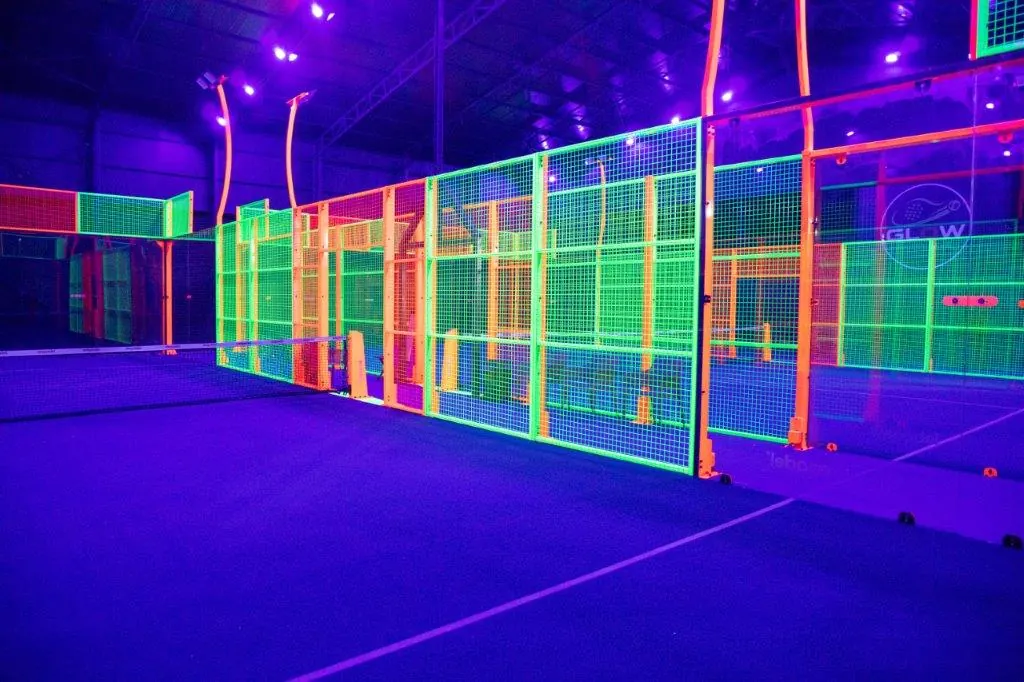
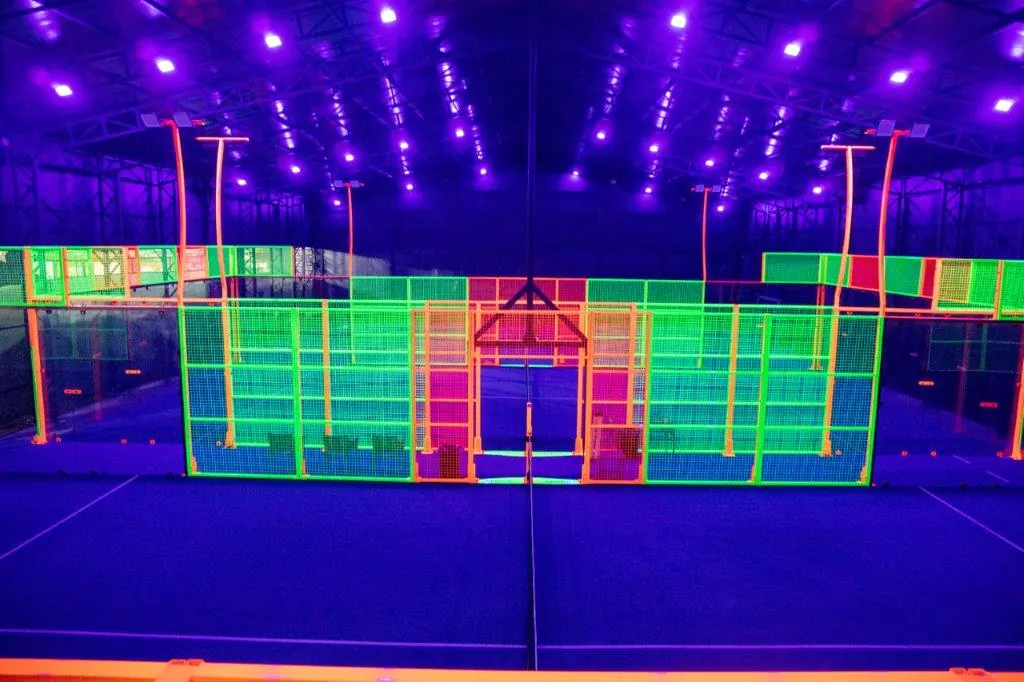
Indoor courts: lights, reflections and glow padel
Indoors, the biggest enemy is reflection. Ceiling floodlights, windows and the glass walls themselves can bounce light off a glossy screen. Mount the screen so that the main lights are not directly in front of it, tilt it slightly downwards if you can, and check it with all court lights on.
Glow padel and other dark venues have the opposite problem: very little ambient light, strong colored lighting, and a screen that can be the brightest thing in the room. A theme that is designed for the dark looks right there and does not dazzle.
Choosing a theme for the light
Every court TV can use its own screen theme while the live score stays the same:
- Classic puts each pair in a bold row with the game score in large color blocks, readable from the far end; a safe choice for bright halls and outdoor screens.
- Pro keeps huge game-score numerals in the center and nothing else in the way.
- Neon uses glowing yellow and blue arcs around the score and is made to stand out in the dark, which suits glow padel.
- Platinum is minimal and metallic, a good match for modern indoor clubs with controlled lighting.
The padel scoreboard themes guide shows all six on a padel court.
A placement checklist
- The game score is readable from the furthest corner of the court
- No direct sun or ceiling light reflects off the screen at busy hours
- The screen faces one court only
- Outdoor screens are rated for outdoor or high-brightness use and protected from rain
- The TV has a stable internet connection at its final position
- The join QR code on the TV can be scanned from where players stand between matches
Plans and hardware
No dedicated scoreboard hardware is needed: each court uses a TV or display with an internet connection and either a streaming app or an HDMI input. Plans are per court: Starter $44/month for one court and one sport, Pro $134/month for up to five courts, Elite $224/month for up to ten courts and Unlimited $1,299 per court one-time, with no term limit. Full details are on the pricing page.
Frequently asked questions
Can a normal TV be used on an outdoor padel court?
A normal indoor TV is not made for direct sun or rain. For open-air courts, use a display intended for outdoor or high-brightness use and protect it from the weather.
Where is the best place for a padel scoreboard?
Usually outside the court, above or beside the back glass, or on a wall facing the court, as long as the score is readable from the far baseline and the screen does not reflect the lights.
Does the scoreboard software work differently outdoors?
No. The live score, themes and phone control are the same; only the choice of display and its protection change.
Which theme is easiest to read from far away?
Classic and Pro keep the game score very large. In dark venues such as glow padel, Neon is designed to stand out.
Should one screen serve two courts?
No. Each court needs its own score, so give every court its own screen.
Not sure where your screens should go? Request a demo and we will look at your courts with you.
Explore the Multi Score Screen digital scoreboard for padel, tennis, pickleball and 5 more sports →