
Tennis Scoreboard App: Keeping Score From Your Phone
By the Multi Score Screen team6 min read
Main guide: Tennis scoreboard guide
In this guide
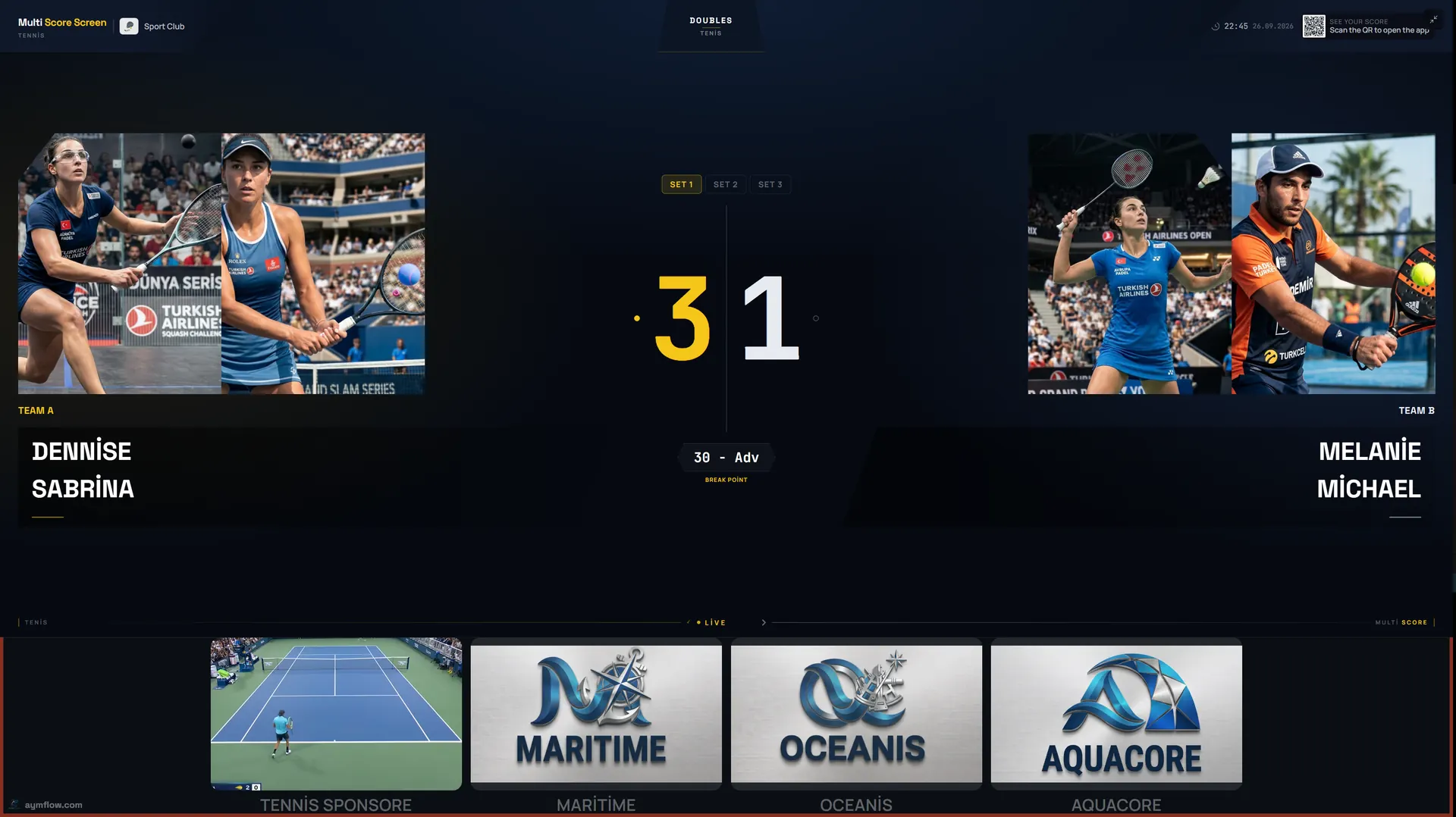
A tennis scoreboard app lets a player, a coach or an umpire keep the score on a phone while the court TV shows it to everyone. With Multi Score Screen there is no app to install: you scan the QR code on the court TV, enter the PIN shown beside it and your phone becomes the controller for that match. Each point you tap appears on the TV straight away, with games, sets, deuce and tiebreaks counted for you.
How a phone takes over a tennis court
Between matches, the court TV shows a join QR code and a PIN. The flow for the players walking on court is short:
- Scan the QR code with the phone camera. The scoring screen opens in the mobile browser; there is no app store and no player account.
- Enter the PIN shown on the TV. It links the phone to that one court, so a player on the next court cannot score your match by mistake.
- Check the match details, such as player names and who serves first.
- Tap the winner of the first point. The TV updates instantly.
When the match ends and the court resets, a fresh QR code and PIN appear for the next booking.
One input per point
The phone does not ask you to remember the score; it asks one question per point: who won it? From that, the scoreboard works out the rest:
| What happens on court | What you tap | What the TV shows |
|---|---|---|
| A normal point | The side that won it | 15, 30, 40 or game |
| Point at 40-40 | The side that won it | Advantage, or back to deuce |
| Last point of a game | The side that won it | New game count in the set; server changes |
| 6-6 in games | The side that won each point | Tiebreak count 1, 2, 3 … to seven with a two-point lead |
| Wrong side tapped | Undo | The previous score, without restarting the match |
This matters most in tiebreaks, where the serve changes after the first point and then every two points, and players change ends every six points. That is exactly when players lose track, and the screen keeps the count.
Singles, doubles and who holds the phone
In singles one player usually scores, often the server, because they call the score before serving anyway. In doubles the question is which of four players does it. Clubs tend to agree on simple habits:
- Social doubles: whoever brought the phone scores; the others check the TV at changeovers.
- League matches: the home side scores, or each side takes one set.
- Lessons: the coach scores practice sets and tiebreak drills so players can focus on the drill.
- Finals: a neutral umpire in referee mode.
Leave the phone on the bench or by the net post rather than in a pocket. Tennis gives you natural pauses: tap the point while picking up balls, and use the 90-second changeover to glance at the screen and confirm the score.
Referee mode for umpires
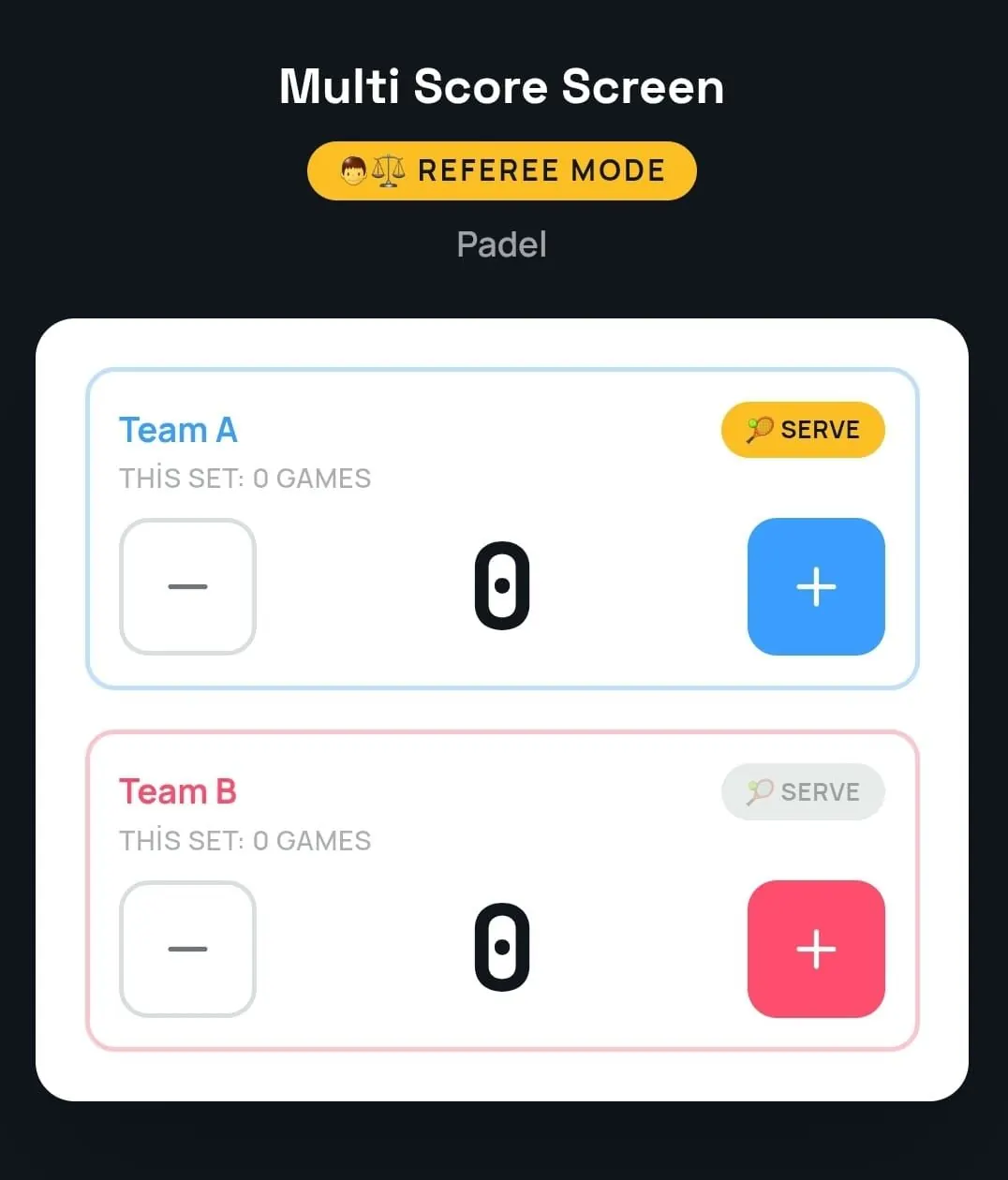
Referee mode turns the phone into a match console with plus and minus buttons for each side, the serve indicator and the games in the current set. A chair umpire, coach or staff member can add a point, take one back or set the server, and the TV follows. It is the official score, entered by hand, with no court sensors required.
Clubs use it for championship finals, showcase matches and junior events where young players should concentrate on playing. How referee mode fits into a full event day is described in the tennis tournament scoreboard guide. Optical sensors that detect points automatically come with the Unlimited plan; without them, referee mode is how an official tennis score is kept.
If the connection dips
Tennis courts are often far from the clubhouse router. If the venue's Wi-Fi drops for a moment, scoring keeps working and syncs once the connection returns, so nobody needs to re-enter points. If a phone or TV cannot connect at all, the tennis scoreboard Wi-Fi guide explains how to plan coverage across a row of courts.
Watching without scoring
Scanning the QR code also opens a live link to the match in a mobile browser, with nothing to install. Parents watching a junior match from the car park, teammates waiting on the next court or the tournament desk can all follow the score. Player names and photos used for a match are temporary and are removed when the match ends.
Compared with a general remote app
Our general scoreboard remote control app guide covers phones, tablets and remotes for any sport. For tennis, what matters is that the app understands deuce, advantage, tiebreaks and the order of service, so the person scoring only taps one side per point. If your club plays special formats such as no-ad games or a match tiebreak in place of a third set, check them with us during a demo before relying on them in an event.
What you need
Any modern smartphone with a browser works as the controller. Each court needs a TV or display with an internet connection and either a streaming app or an HDMI input. Plans are licensed per court: Starter ($44/month) for one court and one sport, Pro ($134/month) for up to five courts and all eight sports, Elite ($224/month) for up to ten courts, and Unlimited at $1,299 per court one-time, with no term limit and optical sensors included. See the pricing page.
Frequently asked questions
Do I need to download an app to score tennis on the court TV?
No. Scan the QR code on the TV and enter the PIN; the scoring screen opens in the phone's browser.
Does the app work out deuce and tiebreaks?
Yes. You only tap who won each point; the scoreboard applies deuce, advantage and tiebreak scoring.
Can an umpire take over the score?
Yes. Referee mode gives the umpire plus and minus buttons for each side, the serve indicator and the games in the set.
What if I tap the wrong player?
Use undo. Point and game undo correct the mistake without restarting the match.
Can friends follow the match from somewhere else?
Yes. The live link opens the match in any mobile browser so others can follow the score.
Want to try it on your own court? Request a demo and score a tennis point from your phone during the call.
Explore the Multi Score Screen digital scoreboard for padel, tennis, pickleball and 5 more sports →